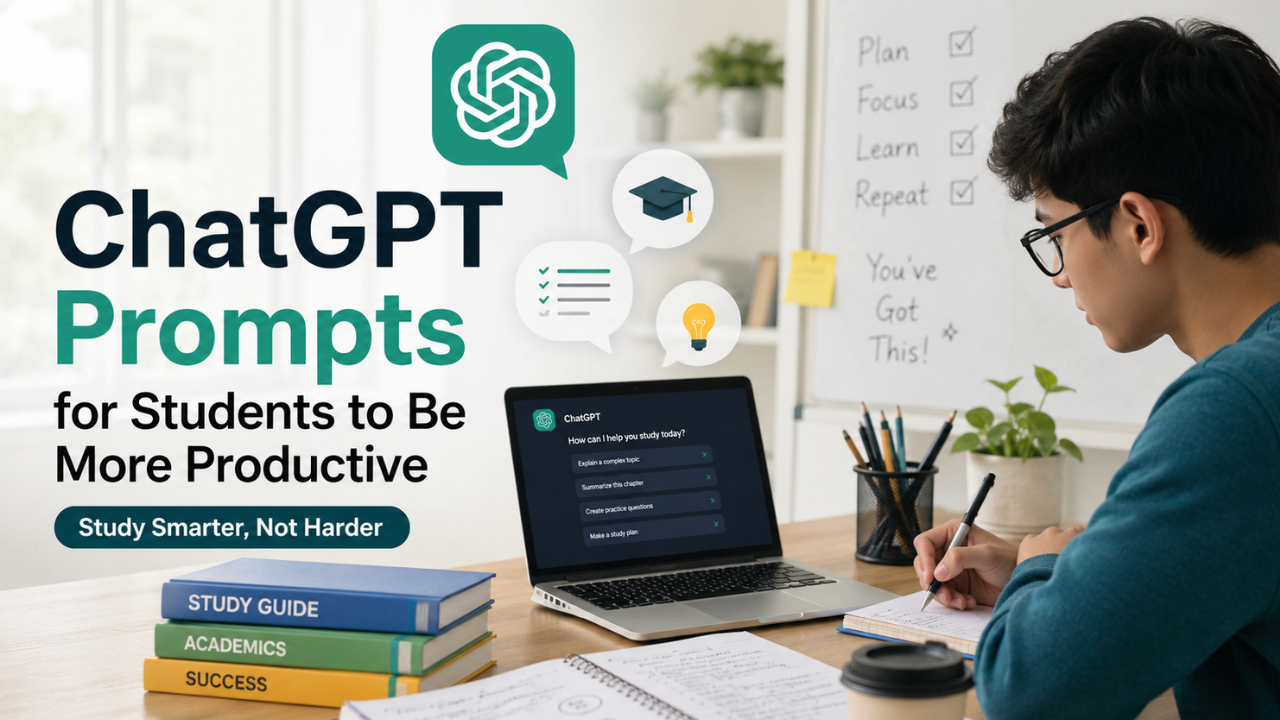
In today’s fast-paced digital era, students are expected to be versatile and efficient in handling a wide range of academic tasks. From conducting in-depth research and writing persuasive essays to understanding complex concepts, academic challenges can often feel overwhelming. However, the emergence of Large Language Model technology such as ChatGPT has opened a new chapter in higher education. No longer just a simple tool, ChatGPT has the potential to become a personal digital assistant that boosts productivity, accelerates learning, and even helps generate brilliant ideas.
The key to unlocking ChatGPT’s full potential lies in the prompts you provide. Clear, specific, and well-structured prompts produce responses that are far more relevant and useful. This article serves as a comprehensive guide featuring a collection of effective ChatGPT prompts designed specifically to help students overcome various aspects of university life. Let’s explore the different prompt categories you can use.
I. Research and Information Gathering
Research is at the heart of many academic assignments. ChatGPT can help you speed up the process and gain deeper insights.
- “Explain the concept of [concept name] in the context of [course/field of study].”
(Example: “Explain the concept of cognitive dissonance in the context of social psychology.”) - “List five recent academic journal articles (published within the last five years) on [research topic].”
(Example: “List five recent academic journal articles (published within the last five years) on the impact of social media on adolescent mental health.”) - “Provide a summary of the main points from the following article: [paste article text].”
(Very useful for quickly understanding lengthy articles.) - “What are the main arguments for and against the issue of [issue name]?”
(Example: “What are the main arguments for and against the legalization of medical marijuana?”) - “Find the latest statistical data on [topic] in Indonesia.”
(Example: “Find the latest statistical data on unemployment rates among bachelor’s degree graduates in Indonesia.”) - “Compare [Theory 1] and [Theory 2] in terms of [comparison aspect].”
(Example: “Compare behaviorism and cognitivism in terms of the learning process.”) - “Provide a case study relevant to [concept/theory] in the context of [context].”
(Example: “Provide a case study relevant to supply and demand in Yogyakarta’s property market.”) - “What research methodologies are commonly used in studies about [topic]?”
(Example: “What research methodologies are commonly used in studies on the effectiveness of online learning?”) - “Provide an operational definition for the variable [variable name] in research about [topic].”
(Example: “Provide an operational definition for the variable ‘learning motivation’ in research on the impact of teaching styles.”) - “List the key figures who contributed to the development of [theory name].”
(Example: “List the key figures who contributed to the development of the theory of evolution.”)
II. Essay and Report Writing
ChatGPT can assist you throughout the writing process, from brainstorming to editing.
- “Give me five engaging essay title ideas about [essay topic].”
(Example: “Give me five engaging essay title ideas about the impact of artificial intelligence on the future job market.”) - “Create an essay outline on [essay topic] with relevant main points and subpoints.”
- “Write an engaging introduction for an essay about [essay topic].”
- “Explain the argument [main argument] using concrete examples in the context of [context].”
- “Paraphrase the following paragraph in a more academic/casual writing style: [paste paragraph].”
(Useful for avoiding plagiarism and adjusting writing style.) - “Provide several effective transition sentences between paragraphs discussing [Topic 1] and [Topic 2].”
- “Write a conclusion that summarizes the main points and includes a call to action (if relevant) for an essay about [essay topic].”
- “Check the grammar, spelling, and punctuation of the following paragraph: [paste paragraph].”
- “Suggest ways to strengthen the argument [argument] in this essay.”
- “Provide more formal or precise word alternatives for the word [word] in the following sentence: [paste sentence].”
III. Understanding Course Materials
ChatGPT can act as a virtual tutor to help you understand difficult concepts.
- “Explain the concept of [concept name] in simple, beginner-friendly language.”
- “Provide an analogy to help me understand the concept of [concept name].”
(Example: “Provide an analogy to help me understand the concept of a supply chain.”) - “What is the main difference between [Concept 1] and [Concept 2]?”
- “Create practice questions with detailed explanations for the topic [subject material].”
- “Explain the steps for solving [problem type] in [course name].”
(Example: “Explain the steps for solving indefinite integral problems in calculus.”) - “Create a concise summary of the key points from the lecture on [topic].”
- “Test my understanding of [topic] by creating several multiple-choice questions along with the correct answers.”
- “Explain the practical applications of [concept name] in everyday life.”
- “Create a simple mind map for the topic [topic].”
- “Explain the topic [topic] in the style of a [profession/famous figure].”
(Example: “Explain the theory of relativity in the style of an enthusiastic physics teacher.”)
IV. Presentation Preparation
ChatGPT can help you design engaging and informative presentations.
- “Give me five engaging opening ideas for a presentation about [presentation topic].”
- “Create a logical and well-structured presentation outline about [presentation topic].”
- “Suggest effective visuals (charts, images, videos) to explain the point [presentation point].”
- “Write a short presentation script for a slide about [slide content].”
- “Provide tips for delivering an engaging and effective presentation.”
- “Suggest ways to answer audience questions confidently.”
- “Create a summary of the key presentation points for the final slide.”
- “Give me an icebreaker idea related to [presentation topic].”
- “Recommend online presentation tools that are attractive and easy to use.”
- “Write an impactful presentation closing statement.”
V. Idea Development and Creativity
ChatGPT can help you brainstorm and generate fresh ideas.
- “Provide 10 innovative research project ideas in [field of study].”
- “Suggest creative solutions to solve the problem of [problem name] in the context of [context].”
- “Brainstorm unique and relevant thesis title ideas related to [field of study].”
- “Expand the concept of [concept name] into several practical application ideas.”
- “Provide a different perspective on the issue of [issue name].”
- “Suggest ways to improve creativity during the writing process.”
- “Create an unusual analogy to explain the concept of [concept name].”
- “Generate engaging social media content ideas related to [course topic].”
- “Suggest ways to combine two different concepts ([Concept 1] and [Concept 2]) into a new idea.”
- “Provide inspiration from [famous figure] to solve [problem].”
Tips for Using ChatGPT Prompts Effectively
- Be Clear and Specific: The more detailed your prompt, the more relevant the response will be.
- Provide Context: Include relevant background information so ChatGPT can better understand your request.
- Use the Right Keywords: Choose accurate keywords that match the topic you’re looking for.
- Experiment with Writing Styles: Try different writing styles and instructions to discover the best results.
- Iterate and Refine: If the first response isn’t satisfactory, don’t hesitate to revise your prompt and try again.
- Request a Specific Format: If you want the output in a particular format (such as a list, outline, or table), mention it in your prompt.
- Set Limitations: If you need a specific number of responses (for example, “list five ideas”), include that limitation in your prompt.
- Assign a Role: Ask ChatGPT to act as an expert, tutor, or research assistant to receive different perspectives.
(Example: “Act as a history professor and explain…”) - Verify Information: Remember that ChatGPT is a supporting tool. Always verify information using credible sources.
- Use It Ethically: Do not use ChatGPT for plagiarism or other forms of academic misconduct. Use it to improve your understanding and enhance the quality of your work—not to replace your own effort and critical thinking.
ChatGPT can be a game changer for students when used wisely and effectively. By mastering the art of writing effective prompts, you can transform this AI assistant into an invaluable study partner. The prompt collection above is only the beginning. Don’t be afraid to experiment, be creative, and customize your prompts to suit your unique needs. Enjoy exploring the limitless potential of ChatGPT throughout your academic journey!
Have You Tried ChatGPT Yet? Start Using It Today!
Want to finish assignments faster? Make your thesis more organized? Or simply need easy-to-understand explanations for your coursework?
ChatGPT is ready to help you 24/7.